

Blog
How to Nurture Leads Effectively: A Step-by-Step Strategy for Business Growth

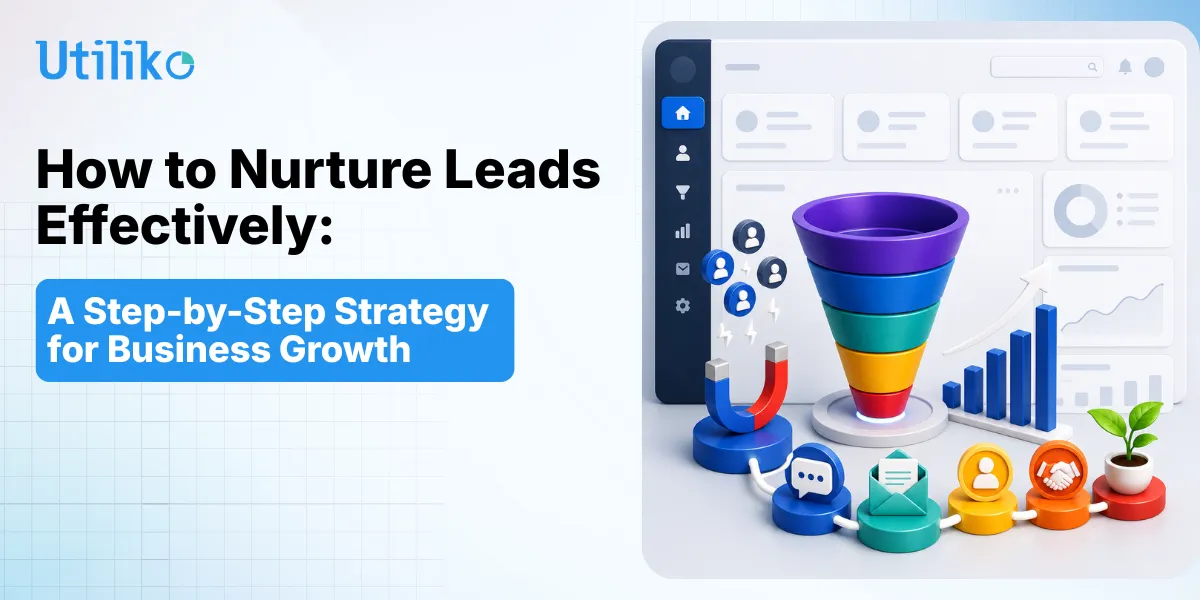
Seventy-nine percent of marketing leads never convert into sales. Not because the leads were bad — but because no one followed up with the right message at the right time. For sales reps, SDRs, and revenue teams, that’s not a pipeline problem. It’s a nurturing problem.
A deliberate lead nurturing strategy is what turns a list of contacts into a predictable revenue engine. It’s the difference between chasing cold prospects and having warm, educated buyers come to you already convinced. This guide covers the full picture: from building buyer personas and scoring leads, to multi-channel sequences, automation tools, post-sale retention, and the metrics that tell you whether any of it is working.
What Is a Lead Nurturing Strategy — and Why Does It Define Your Revenue Ceiling?
A lead nurturing strategy is a structured, ongoing process of delivering relevant, timely value to prospects at every stage of their buying journey — with the goal of building enough trust and conviction that they choose you when they’re ready to buy.
The word “ongoing” is doing heavy lifting in that definition. Most sales teams treat nurturing as a one-time email blast or a two-touch follow-up sequence. That’s not nurturing — that’s a missed opportunity at scale.
Effective nurturing works because it addresses a fundamental reality of B2B buying: the majority of leads in your pipeline right now are not ready to buy today. A consistent nurturing strategy keeps you present and credible throughout the evaluation window — so when the moment arrives, you’re the obvious choice.
The business case is straightforward:
- Nurtured leads produce, on average, a 20% increase in sales opportunities versus non-nurtured leads
- Companies that excel at nurturing generate 50% more sales-ready leads at 33% lower cost
- B2B buyers typically consume between 3 and 7 pieces of content before engaging with a sales rep
Beyond pipeline volume, nurturing also shortens sales cycles, reduces cost per acquisition, and improves lead-to-close rates — all metrics that matter to sales managers, RevOps teams, and business owners alike.
Understanding where lead nurturing fits within the broader revenue lifecycle — from first touch through billing and renewal — is covered in depth at What Is Lead-to-Cash? Your Business Revenue Cycle Explained.
Start With the Foundation: Buyer Personas and Sales Cycle Mapping
Before building a single sequence or scoring a single lead, two foundational inputs need to be in place: a clear picture of who you’re talking to, and a clear picture of how long it takes them to buy.
Build Buyer Personas From Real Data, Not Assumptions
A buyer persona is a detailed profile of your ideal customer built from what you actually know about people who have already bought from you. For sales teams and RevOps professionals, personas serve a specific function: they tell you what content to send, what channel to use, and what language will resonate at each stage of the funnel.
For each major customer segment, document:
- Role and seniority: job title, reporting structure, decision-making authority
- Primary goals: what does success look like in their role this quarter?
- Core pain points: what problem are they actively trying to solve right now?
- Buying triggers: what event typically causes someone in this role to start evaluating a solution?
- Content preferences: long-form reports, short video demos, peer benchmarks, ROI calculators
- Objection patterns: what reasons do people in this role typically give for not buying or delaying?
The practical difference: a marketing director at a B2B SaaS company and an operations manager at a field service business might both need CRM software — but they have entirely different concerns, vocabularies, and decision timelines. The same email sent to both is wasted on at least one of them.
Pro Tip: Pull persona data from CRM records, closed-won interview notes, and post-sale conversations. Real language from real customers is always more persuasive than copy written from intuition.
Map Your Sales Cycle Before You Set Sequence Timing
The length of your typical sales cycle is the backbone of your nurture sequence design. A business where deals close in two weeks needs a completely different nurturing architecture than one where the average deal takes six months.
Calculate your average time-to-close by deal type using your CRM pipeline data. Then use this number to calibrate:
- How many emails to send and over what timeframe
- When to escalate from low-touch to high-touch engagement
- When to trigger a sales rep handoff
- How long to wait before re-engaging a cold lead
A 5-email sequence sent over 14 days won’t move a 90-day deal. If your CRM data isn’t deep enough yet, interview your last 10–15 clients and ask how long they considered the decision before reaching out.
How to Create an Effective Lead Nurturing Strategy for B2B Companies
With personas and sales cycle data in hand, you can build the actual strategy. The architecture has five layers: segmentation, lead scoring, content mapping, channel selection, and automation.
Step 1 — Segment Your Database Before Sending Anything
Segmentation is the practice of grouping leads by shared characteristics so your communication speaks directly to what matters to each group. The four segmentation dimensions that drive the most impact in B2B:
Funnel stage: A top-of-funnel lead who found you through a blog post needs entirely different content than a bottom-of-funnel prospect who just attended a demo. Mixing them in the same sequence produces irrelevant messaging for both.
Behavioral engagement: Actions tell you more than demographics. A lead who has visited your pricing page three times, downloaded a case study, and opened your last four emails is signaling readiness regardless of their job title. CRM Activity Tracking: How to Auto-Log Calls, Emails & Meetings covers how to capture these signals automatically without relying on manual rep logging.
Firmographic profile: Company size, industry, geography, and tech stack all affect what content resonates. A 10-person agency and a 500-person manufacturer have different budgets, decision processes, and pain points.
Persona type: Economic buyers want ROI and risk reduction. Technical evaluators want integration specs and security documentation. End users want ease of use and workflow fit. Each needs its own content track.
To execute segmentation at scale, use CRM Tags and Labels to Segment Your Database — one of the fastest ways to create actionable segments without rebuilding your entire CRM structure.
Step 2 — Build a Lead Scoring Model to Surface Sales-Ready Prospects
Lead scoring assigns a point value to each lead based on their actions and profile, creating a numerical representation of how close they are to being sales-ready. It’s the mechanism that connects marketing nurturing activity to sales outreach timing.
A practical scoring framework for B2B:
| Action / Attribute | Score |
|---|---|
| Requested a demo | +30 |
| Replied to a nurture email | +20 |
| Visited pricing page | +15 |
| Attended a live webinar | +15 |
| Downloaded a case study or guide | +10 |
| Opened 3+ emails in a sequence | +10 |
| Matches target industry | +10 |
| Matches ideal company size | +10 |
| Matches target seniority level | +10 |
| No activity in 60+ days | -15 |
| Unsubscribed from email | -25 |
Set two thresholds: the MQL threshold (worth continued marketing investment) and the SQL threshold (ready for a direct sales conversation). For most SMB B2B businesses, 50+ points = MQL and 80+ = SQL is a defensible starting point — but calibrate against your own historical data.
Factor in your sales cycle length. Before you set MQL/SQL thresholds, understand how long your typical sales cycle actually runs. Map your average time-to-close by deal type and use this as the backbone of your sequence timing. Your CRM’s pipeline data is the fastest way to calculate this — if data is thin, interview your last 10 clients and ask how long they considered the decision before reaching out.
Step 3 — Map Your Content to the Buyer Journey
Top of Funnel — Awareness: The lead is recognizing a problem. Content should educate without selling. Best formats: SEO blog posts, thought leadership articles, industry benchmarks, short explainer videos, downloadable templates (gated). Nurturing goal: capture contact info and establish credibility.
Middle of Funnel — Consideration: The lead is comparing solutions. This is the most underinvested stage in most B2B programs. Best formats: email drip sequences (3–7 emails over 2–4 weeks), vendor comparison guides, detailed case studies, ROI calculators, webinars. Nurturing goal: differentiate your solution and build enough confidence for a direct conversation.
Bottom of Funnel — Decision: The lead is close to choosing. Best formats: free trials and demos, client testimonials and reference calls, security documentation, limited-time incentives, direct outreach from a senior rep or founder. Nurturing goal: remove the final objections standing between the lead and a decision.
Step 4 — Build a Multi-Channel Nurture Mix
Email is the operational backbone of most nurture sequences — but restricting nurturing to a single channel leaves significant conversion potential untouched. The most effective B2B programs coordinate across at least three channels.
| Channel | Best Stage | Core Strength | Key Consideration |
|---|---|---|---|
| Email sequences | All stages | Scalable, measurable, automatable | Audit sequences every 6 months |
| LinkedIn outreach | Consideration, Decision | Direct, personal, credibility-building | Easy to read as spam if not personalized |
| Retargeting ads | Awareness, Consideration | Keeps brand visible between email touches | Set frequency caps to avoid ad fatigue |
| Direct sales outreach | Decision | Highest-conversion at the right moment | Requires proper SQL qualification first |
| SMS / WhatsApp | Decision | 98% open rates; immediate | Requires explicit opt-in; use sparingly |
| Webinars and events | Consideration | Builds trust and authority at scale | High production overhead; needs promotion |
Step 5 — Build the 5-Email Nurture Sequence That Converts
Email 1 — The Welcome (Day 1): Confirm the opt-in, deliver the promised resource immediately, and set clear expectations for what comes next. Keep it under 150 words. Use a real sender name — humans reply to humans.
Email 2 — The Problem (Day 3): Articulate the core pain point your lead is likely experiencing — without pitching your solution. When a prospect reads this email and thinks “how do they know that?”, you’ve done it right.
Email 3 — The Education (Day 7): Share your highest-value insight: a counterintuitive data point, a framework they haven’t seen before, or a case study that reframes the problem. This is the email that builds authority.
Email 4 — The Social Proof (Day 12): Share a specific client outcome that mirrors the lead’s situation. “A 45-person field service company reduced quote-to-invoice time by 60% in 90 days” is worth ten times more than a generic testimonial.
Email 5 — The Soft CTA (Day 18): Invite the next step with zero pressure: a 20-minute call, a free trial, a specific question they can reply to. Make it easy to say yes and easy to say not yet — both are useful signals.
Re-engagement branch: If a lead opens fewer than two of emails 3–5, trigger a separate 3-email re-engagement track with completely different subject lines and a “Did we lose you?” close. Reactivated leads from this branch frequently convert at above-average rates.
For service businesses managing high-volume follow-up at scale, Automated Sales Follow-Up for Service Businesses: The Complete 8-Step System covers how to build and maintain this end-to-end without manual oversight.
High-Touch vs. Low-Touch: How to Allocate Your Nurturing Effort
One of the most important decisions in any nurturing program is not what content to create — it’s how much time and personalization to invest per lead. Treating a $2,000 deal the same as a $200,000 deal is a resource allocation failure that quietly caps your revenue ceiling.
High-Touch Leads: Maximum Personalization, Maximum Investment
High-touch leads show strong behavioral engagement and significant revenue potential. They justify the investment of deep personalization and direct rep involvement.
- Research the prospect’s company before every outreach — reference a recent announcement or industry challenge
- Build a customized ROI calculation for their specific team size and use case
- Offer direct access to a senior team member or founder for a discovery conversation
- Send personalized video messages using tools like Loom rather than template emails
- Follow up the same day when a high-score lead takes a meaningful action
Low-Touch Leads: Consistent Value, Minimal Manual Investment
Low-touch leads have lower engagement scores or smaller deal sizes. They still deserve to be nurtured — just through automation, not manual rep time. Low-touch nurturing runs largely on autopilot: a monthly newsletter, a triggered email when they download something new, a quarterly check-in. The per-lead cost is minimal, but the cumulative effect over a large low-touch database is significant.
The “No Bad Lead” Principle
There is a third category most frameworks miss: leads who don’t fit your current ideal profile but are worth keeping in a long-term warm track. The contact who can’t afford you today may switch companies in six months. The person who isn’t the decision-maker today may be promoted next year. A simple low-frequency track — one piece of genuinely useful content per month, no hard CTAs — costs almost nothing to maintain.
For structuring the sales handoff between marketing-owned low-touch tracks and rep-owned high-touch engagement, Pipeline Management Software: The 7 Best Systems for Your Sales Team in 2026 covers how to build this transition into your pipeline tool.
What Is a Lead Nurturing CRM — and Which Tools Should You Use?
A lead nurturing CRM is a platform that combines contact management, behavioral tracking, automated communication workflows, and lead scoring into a single system — so every lead receives the right message at the right stage without manual intervention at every step.
The distinction that matters: a basic CRM stores contact data. A nurturing-focused CRM actively triggers actions based on what leads do — visiting a pricing page, opening a third email, clicking a specific link, or going silent for 45 days. That behavioral trigger layer is what transforms a contact database into a revenue system.
Before evaluating any platform, read How to Choose a CRM: A 10-Point Checklist for Small and Medium-Sized Businesses to understand which capabilities to prioritize for your team size and sales model.
Lead Nurturing Automation Tools Compared
| Tool | Best For | Key Features | Pricing |
|---|---|---|---|
| HubSpot | All-in-one SMB teams | CRM + email automation + lead scoring + reporting | Free tier; paid from ~$50/mo |
| ActiveCampaign | Email-first automation | Advanced conditional sequences, deep segmentation | From ~$29/mo |
| Mailchimp | Early-stage businesses | Simple drip sequences, templates, list management | Free tier available |
| Pipedrive | Sales-led teams | Visual pipeline + email sequences + activity tracking | From ~$24/mo |
| Keap (Infusionsoft) | Service businesses | Automation + appointment booking + invoicing | From ~$299/mo |
| Zoho CRM | Budget-conscious teams | Lead scoring + workflow automation + analytics | Free tier; paid from ~$14/mo |
| Utiliko (utiliko.io) | Service-based businesses | CRM + job tracking + client management + follow-up automation | Contact for pricing |
When shortlisting tools, prioritize: behavioral trigger capability (not just time-based delays), visual sequence builders, native CRM integration, and the ability to sync lead scores to sales rep workflows in real time.
For a full side-by-side platform evaluation, see The Complete CRM Comparison Guide. One implementation detail most teams overlook: migrating contacts from a legacy system without cleaning the data first will silently corrupt your scoring model from day one. CRM Data Migration: Move Your Data Without Losing a Lead walks through exactly how to clean and migrate cleanly.
What Are Effective Strategies for Nurturing Cold Leads Into Sales Opportunities?
Every pipeline has cold leads — prospects who engaged months ago and then went quiet. The instinct is to write them off. That’s almost always the wrong call. Cold leads have already demonstrated intent. They went cold because the timing wasn’t right, the content wasn’t relevant, or the follow-up dried up.
The 3-Step Cold Lead Re-Engagement Sequence
Step 1 — The Pattern Interrupt: Don’t send the same kind of email that got ignored before. Subject lines like “Still relevant?” or “Checking in — no pressure” consistently outperform branded, polished outreach on cold lists. Keep the email short, conversational, and low-stakes.
Step 2 — The Value Drop: If Step 1 gets an open but no reply, follow three days later with something genuinely new — a recent case study from their industry, a relevant benchmark report, or a feature released since they last engaged. Give them a reason to reconsider that isn’t about you.
Step 3 — The Graceful Exit: If there’s still no engagement after two touches, send a final email offering a clean choice: unsubscribe, or opt back in for a specific content topic. Those who don’t re-engage will clean your list, improving deliverability for every future send.
Common Lead Nurturing Mistakes That Kill Pipeline
- Treating all leads identically — Segmentation isn’t optional. Use CRM Tags and Labels to Segment Your Database to create workable segments fast.
- Pitching before trust is established — A sales pitch in the second email tells the prospect you’re not interested in their problem. The first three emails should add value with no ask whatsoever.
- Abandoning the middle of the funnel — Most teams invest heavily in TOFU lead generation and BOFU closing. MOFU is where leads stall most often — and where strategic content investment produces the highest conversion impact.
- No agreed handoff protocol — Marketing and sales need a written definition of what constitutes a sales-ready lead. Without it, reps call leads too early, damage relationships, and blame marketing.
- Automation without auditing — A sequence that was effective 12 months ago may be actively hurting you today if the content is outdated or the links are broken. Every active sequence deserves a quarterly review.
Don’t Stop Nurturing After the Sale: How to Build Loyalty and Drive Referrals
Most nurturing guides end at the point of conversion. That’s a costly place to stop. The relationship equity you built to win a client is exactly the asset you need to retain them, grow them, and convert them into a referral source.
Reducing churn through structured onboarding: The first 30–60 days post-sale carry the highest churn risk. A structured onboarding sequence that checks in at predictable intervals, surfaces early wins, and proactively resolves confusion dramatically reduces silent disengagement. Most clients who churn in the first 90 days do so because they never fully activated — not because the product was wrong for them.
Driving account expansion through behavioral signals: Clients who are actively using your product show expansion signals in their usage data. A client who has maxed out a feature tier or added multiple users is likely ready for an upgrade conversation — if you’re watching for it. Behavioral data should trigger expansion outreach, not a calendar reminder.
Creating referrals through surprise-and-delight moments: A handwritten note after a milestone. A personalized check-in three months post-launch. Early access to a new feature before public release. These moments create the kind of emotional memory that produces referrals — not because you asked for them, but because the client genuinely wanted to tell someone.
“The higher your customer lifetime value, the more valuable a buyer is to your business — they tend to generate more revenue and are more likely to be loyal.” — Gartner
What Are the Key Metrics to Track for Lead Nurturing Campaign Success?
Numbers tell you what’s happening. Testing tells you why. Both are required for a nurturing program that improves over time.
- Email open rate — B2B benchmark: 25–35%. Sustained below-benchmark open rates point to subject line quality, sender reputation, or list hygiene issues — not content quality.
- Click-through rate (CTR) — B2B benchmark: 3–5%. Low CTR on high-open emails means the content isn’t delivering on the subject line’s promise, or the CTA isn’t clear enough.
- MQL-to-SQL conversion rate — Target: 20%+. Sustained below-20% performance indicates misaligned scoring thresholds, premature handoffs, or sequences not building enough conviction before the sales conversation.
- Lead velocity — How quickly do leads move through each funnel stage? Stage-specific velocity drops tell you where your content gaps are concentrated.
- Sales cycle length — The most meaningful long-term metric for evaluating nurturing effectiveness. A program working correctly should show gradual compression in average time-to-close.
- Customer lifetime value (CLV) — A metric that post-sale nurturing directly influences. Rising CLV over time indicates that your retention and expansion sequences are working.
- Cost per acquisition (CPA) — Nurturing should progressively reduce CPA versus cold outreach. If it’s not, the automation logic or content quality needs a structural review.
For systematic reporting on these metrics, CRM Reporting 101: 10 Reports to Run Every Week covers the exact reports and cadence that surface issues before they compound.
A/B Testing: How Good Nurturing Programs Become Great Ones
Metrics show you the score. A/B testing shows you how to change it. Test one variable at a time, measure the result on a statistically meaningful sample, apply the winner, and move to the next variable.
- Subject lines — test two versions to the same segment simultaneously; the higher open rate wins
- CTA copy and placement — “Book a 20-Minute Call” vs. “See How It Works for Your Team” can produce dramatically different click rates
- Send timing — test Tuesday morning vs. Thursday midday across a 4-week window before drawing conclusions
- Email length — does your audience prefer tight 100-word emails or longer, data-rich ones? Only your list will tell you
- Content format — test a case study email against a benchmark-data email for the same stage; the winner reveals what your audience values most
Set a testing cadence: active sequence review weekly, full system audit quarterly. Any sequence live for more than six months without a performance review is likely underperforming against its potential.
For authoritative B2B benchmarks on open rates, CTR, and MQL-to-SQL conversion, see the Demand Gen Report.
The 10-Point Lead Nurturing Strategy Checklist
Before launching any nurturing program or campaign, confirm every item below is in place:
- Buyer personas documented — at least one detailed persona per major segment, built from real CRM and sales data, not assumptions
- Sales cycle length mapped — average time-to-close is calculated by deal type and is informing sequence timing and MQL/SQL thresholds
- Database segmented — leads are grouped by funnel stage, behavioral engagement, firmographic profile, and persona type before any sends go out
- Lead scoring model active — MQL and SQL thresholds are agreed between marketing and sales and documented in the CRM
- Content mapped to funnel stage — every major piece of content is tagged to a specific stage (TOFU, MOFU, BOFU) and persona type
- 5-email nurture sequence built — at least one active sequence per major segment, with a re-engagement branch for non-openers
- Multi-channel touches planned — email is not the only channel; at least one additional touchpoint (LinkedIn, retargeting, direct outreach) is in the mix
- High-touch vs. low-touch tiers defined — criteria for high-touch escalation are documented and reps know exactly when to take over from automation
- Post-sale nurture sequence active — existing customers have a structured onboarding and retention track beyond the initial handoff
- A/B testing cadence established — at least one variable is being tested in each active sequence, with a weekly review process in place
Most growing businesses find that lead nurturing doesn’t run in isolation — it’s part of a broader automation ecosystem. 7 Workflows Every Growing Business Should Automate covers the adjacent workflows — onboarding, follow-up, billing — that make nurturing more effective when they run in parallel.
How Utiliko Supports Lead Nurturing for Service-Based Businesses
For service-based businesses managing client pipelines alongside field operations, scheduling, and billing, keeping a nurturing strategy running consistently is difficult without the right infrastructure. Most tools are built for pure SaaS or enterprise sales cycles — not for businesses where the same team is managing quotes, jobs, and client relationships simultaneously.
Utiliko is an all-in-one platform built specifically for service businesses. It combines CRM, client management, job tracking, follow-up automation, and communication tools in a single system — so nurturing activities aren’t siloed from the rest of operations. Teams can track lead status, automate follow-up reminders, manage the full client lifecycle from first contact through service delivery and renewal, and do all of it without stitching together multiple disconnected tools. Learn more at utiliko.io.
Key Takeaways
- Build buyer personas from real CRM data before building any sequence — the more precisely you understand who you’re nurturing, the higher every touchpoint converts, and the faster your scoring model calibrates
- Match nurturing intensity to revenue potential: high-touch personalization for high-value leads, automated low-touch tracks for everyone else, and a warm maintenance sequence for leads that don’t fit today but might tomorrow
- The five-email sequence framework — Welcome, Problem, Education, Social Proof, Soft CTA — gives every lead a structured path from cold contact to sales conversation, with a re-engagement branch for non-openers
- Nurturing doesn’t end at the sale: a structured post-sale onboarding sequence, behavioral expansion triggers, and deliberate surprise-and-delight moments directly drive CLV, referrals, and retention
- A/B test one variable at a time, review active sequences weekly, and audit the full system quarterly — the programs that compound results are the ones that never stop improving
Frequently Asked Questions
What is a lead nurturing strategy?
A lead nurturing strategy is a structured approach to delivering relevant, timely value to prospects across every stage of their buying journey — from first awareness through to purchase decision. It typically combines segmentation, lead scoring, automated email sequences, and multi-channel touchpoints designed to build trust and conviction at the right pace for each buyer.
What are the 3 key elements of a lead nurturing strategy?
The three foundational elements are segmentation (grouping leads by shared characteristics to enable personalized communication), lead scoring (prioritizing leads by engagement level and revenue potential), and content mapping (assigning the right content to the right funnel stage and persona). Without all three working together, nurturing sequences either reach the wrong people, at the wrong time, with the wrong message.
What is the best lead nurturing strategy for B2B companies?
The most effective B2B lead nurturing strategies combine behavioral segmentation, a multi-email drip sequence calibrated to the actual sales cycle length, multi-channel touches across email and LinkedIn, and a clearly defined MQL-to-SQL handoff protocol agreed between marketing and sales. B2B buyers typically consume between 3 and 7 pieces of content before talking to a rep, so the nurturing program needs to be long enough and varied enough to sustain engagement across that full window.
What are the best lead nurturing automation tools?
The right tool depends on your team size, sales model, and technical capacity. HubSpot is the strongest all-in-one option for SMBs needing CRM and email automation together. ActiveCampaign is best for teams wanting advanced conditional sequence logic. Keap is purpose-built for service businesses needing automation alongside appointments and billing. For service-based businesses, Utiliko provides CRM, job tracking, client management, and follow-up automation in a single platform built for their operational model.
How do you know when a lead is ready for a sales conversation?
Lead scoring is the most reliable mechanism — define a numerical threshold that triggers a sales handoff, built from behavioral signals like demo requests, pricing page visits, and email engagement patterns. Qualitative signals matter equally: a lead who replies to a nurture email with a specific question about pricing, implementation timeline, or integration compatibility is typically ready regardless of their score. The key is having a documented, agreed threshold that both marketing and sales have signed off on.
Ready to simplify your customer management process?
Start your free trial today and discover how a modern CRM can help your team work smarter, close faster, and build lasting customer relationships.

More articles
 Blog How to Choose the Best CRM for Sales Team
A rep runs a great discovery call on Monday. By Thursday, nobody can say for certain who owns…
Blog How to Choose the Best CRM for Sales Team
A rep runs a great discovery call on Monday. By Thursday, nobody can say for certain who owns…
 Blog The Complete CRM Comparison Guide: How to Compare CRM Software and Choose the Right One
Seventy percent of CRM implementations fail — not because the software is bad, but because businesses chose the…
Blog The Complete CRM Comparison Guide: How to Compare CRM Software and Choose the Right One
Seventy percent of CRM implementations fail — not because the software is bad, but because businesses chose the…
 Blog Top 10 CRM Platforms for Electrical Contractors in 2026
Managing customer relationships in an electrical business isn’t just about storing phone numbers anymore. Today’s contractors coordinate multiple…
Blog Top 10 CRM Platforms for Electrical Contractors in 2026
Managing customer relationships in an electrical business isn’t just about storing phone numbers anymore. Today’s contractors coordinate multiple…